
Get your exact price
Three quick steps. A real quote for your real bathroom.

Verify us in one tap. We are accredited by the Better Business Bureau. Your quote is written, free and comes with zero obligation.
A caregiver's guide to safe bathing
Helping a parent or spouse bathe safely is part logistics, part kindness. This guide covers the conversation, the setup, the routine and the Florida support you can lean on.
Direct answer: Start with a respectful conversation, then set up the bathroom so your parent or spouse can sit to bathe, hold on securely and reach everything without stretching. Keep a steady routine, stay close without hovering, and call Florida's Elder Helpline at 1-800-963-5337 for local caregiver support.
 Dignity and safety together
Bathing is personal. Start there.
Many of the calls we get in Florida come from adult children. Some live nearby. Many live in another state and visit a parent who retired here. They notice that Mom stopped taking baths, or that Dad grips the towel bar a little too hard. They want to help, but they do not want to take over.
That instinct is right. Bathing is private, and independence matters. The best results we see come from families who involve the bather in every decision, focus on what they can still do alone and add help only where it is needed.
This guide walks through the steps we have seen work. It is not medical advice. A doctor or occupational therapist can tailor it to your loved one.
Signs that bathing has become hard
Fewer baths or showers
Skipped bathing is often the first sign. People rarely say "I am scared of the tub." They say they are tired, or that they will do it later.
Grabbing the wrong things
Towel bars, sink edges and shower doors are not built to hold a person. Loose towel bars or a cracked soap dish can be clues.
New bruises or a near miss
A bruise on the shin or hip, or a story about "almost" slipping, deserves attention. So does any fall, even without injury.
Changes in health
A new hip or knee, a stroke, Parkinson's, worsening arthritis or a new medication can change how safely someone gets in and out of a tub.
How to bring it up without a battle
Lead with what your loved one wants. Most people want to stay in their own home. A safer bathroom is one of the simplest ways to make that possible. Framing it that way turns the talk from "you can't" into "here is how you can."
- Pick a calm moment, not right after a fall or an argument.
- Ask what is hard, and listen before suggesting anything.
- Offer choices: a walk-in tub, a shower with a seat, or grab bars first.
- Let them meet the installer and ask their own questions.
- Involve their doctor if they trust that voice more than yours.
A line that often helps: "I would feel better knowing you have a safer bath when I am not here. Would you look at a few options with me?"
Setting up the bathroom for the bather and the helper
A good setup works for the bather on their own and leaves room for help on harder days.
The right bathing fixture
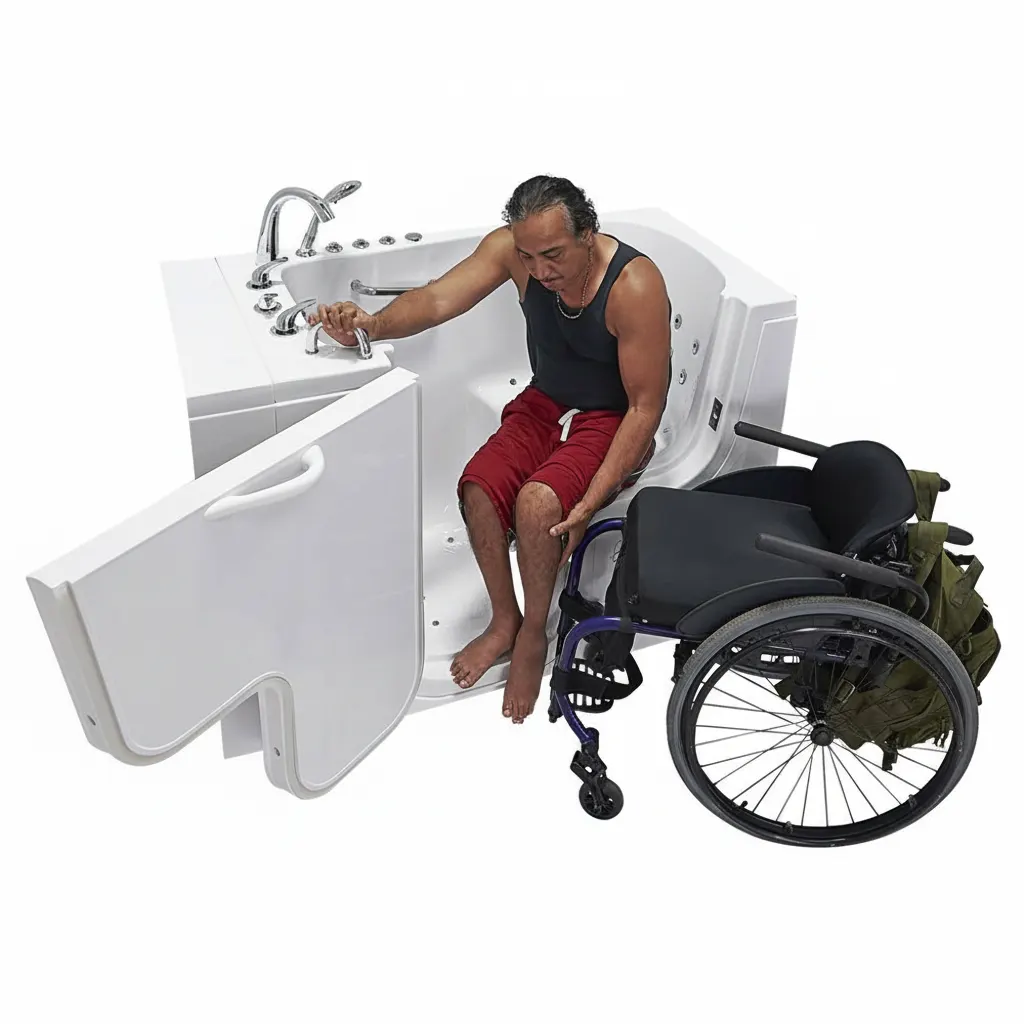
For someone who wants to soak and can step over a low lip, a walk-in tub. For someone who slides from a wheelchair, a transfer tub. For someone who needs hands-on help every time, often a roll-in shower. Our comparison guide walks through it.
Room for the helper
Outward-swing and transfer doors give a caregiver space beside the tub. A handheld shower lets a helper rinse hair and back without leaning over.
Grab bars where hands go
Have the bather go through the motions while dry. Mark where their hands reach naturally, and place bars there.
Everything within reach
Soap, shampoo, washcloth, towel and robe should be reachable from the seat. Reaching and twisting on a wet surface is when balance slips.
A step-by-step routine that keeps dignity intact
- Warm the room first. Run the exhaust fan and close the door to keep heat in.
- Lay out towels, clothing and anything else needed.
- Let the bather do every step they can. Offer help, do not take over.
- Check water temperature with your wrist or a thermometer before they get in.
- Cover with a towel for privacy if you are helping.
- Stay seated while the tub drains, and rinse with the handheld shower to keep warm.
- Stand slowly. Pause. Then step out holding the grab bar.
- Dry feet before walking on tile.
When to call the doctor
If your loved one gets dizzy after bathing, has trouble with hot water because of numb feet, or has heart or blood pressure problems, ask their doctor about safe water temperature and soak time. People with diabetic nerve damage may not feel water that is too hot.
When to get extra help
If bathing has become unsafe even with a better setup, ask about in-home personal care. Your Area Agency on Aging can tell you about local services and how to qualify.
Caring for a Florida parent from another state
Florida has a large population of retirees, and many of their adult children live elsewhere. We often coordinate with a son or daughter by phone and email while a parent stays the decision-maker at home.
Gather photos and numbers
Ask a neighbor or your parent to send photos of the tub, the bathroom door and the electrical panel, plus our six measurements.
Join the calls
We are happy to set up a three-way call so you and your parent hear the same information.
Plan the walkthrough
Try to be there, or have a trusted local person there, on install day so someone hears how the tub works.
Line up local help
Your parent's Area Agency on Aging can connect you with local services you cannot provide from afar.
Florida help for caregivers
Florida Elder Helpline
Call 1-800-963-5337. It connects you with your parent's local Area Agency on Aging for caregiver programs, respite and in-home services.
Elder HelplineAging and Disability Resource Centers
Florida's ADRCs help families understand services and long-term care options, including Medicaid long-term care screening.
Find an ADRCYour local agency
See our list of Florida's 11 Area Agencies on Aging by region.
Help paying
VA, Medicaid and county programs are explained in our paying for a walk-in tub guide.
Caregiver FAQ
My parent refuses to change the bathroom. What can I do?
Start smaller. Grab bars, a handheld shower and a non-slip mat are easier to accept than a new tub. Ask their doctor to weigh in. Many people come around once they see the change as a way to stay independent at home.
Can a caregiver help someone in a walk-in tub?
Yes. An outward-swing or transfer door gives a helper room beside the tub, and a handheld shower makes rinsing easy. For someone who needs full help every time, a roll-in shower may give the caregiver more room.
Can you work with me if I live out of state?
Yes. We regularly coordinate with family members by phone and email while the parent stays involved. Call 1-888-779-2284 to set up a call that includes everyone.
Helping a parent? We are glad to talk with the family.
Free quotes for Florida homes. No pressure.
1-888-779-2284 (BATH)